What heat and humidity cost your marathon, degree by degree
Minutes added to a 3:30, 4:00 and 4:30 marathon from 15 to 30 °C at three levels of humidity, and what Kolkata, Chennai and Mumbai race mornings cost.
· 5 min read · EnduranceLabs
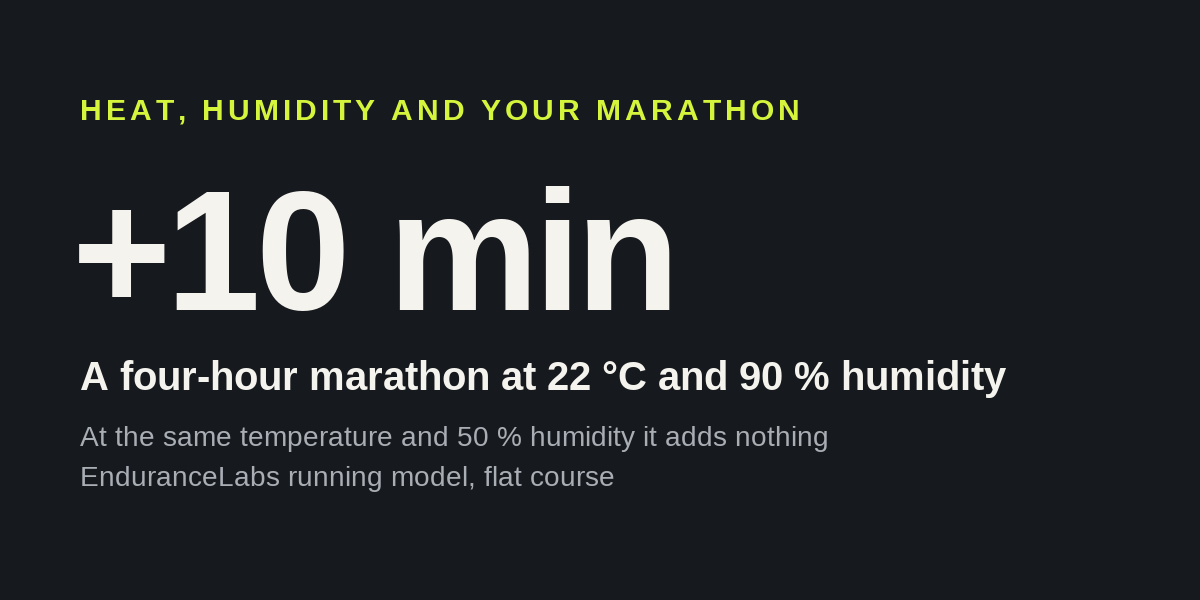
Indian marathons start in the dark to beat the heat, and on most mornings they manage it. The humidity stays. On a coastal race morning the air is close to saturated before sunrise. In the running model behind EnduranceLabs' predictions, a damp 22 °C costs you more than twice as much as a dry 26 °C, and the tables below give the minutes for each degree and each step of humidity, then for the winter races from Kolkata to Mumbai.
What the research found
One of the largest studies of weather and marathon times is by Matthew Ely and colleagues, published in 2007. They took decades of results from seven marathons, including Boston, New York and the Twin Cities, and sorted each race by its wet-bulb globe temperature (WBGT). That's a heat-stress index that combines air temperature, humidity and sun.
- Times slowed steadily as WBGT rose from 5 to 25 °C. The leading men were about 1.7 % off their course records in the coolest races and about 4.5 % off in the warmest.
- Slower runners lost more. The 25th to 300th finishers slowed more with each step of heat than the winners did.
The second finding matters for most of us. A runner out for four or five hours spends longer in the heat, and the morning warms around them as they go.
How EnduranceLabs counts it
The running model behind EnduranceLabs' predictions treats temperature and humidity as two separate costs. Warm air costs time, humid air costs time, and a cool, dry morning takes a little off. It counts each as a share of your finish time, so a slower marathon loses more minutes in the same weather, in line with Ely's second finding.
Humidity gets a cost of its own because of how you cool down. Your sweat cools you only when it evaporates, and in air that is already damp it drips off instead. Relative humidity falls as the sun warms the air (on Chennai race mornings, from 86 % at 6 am to 68 % by 10), so a cool, humid dawn and a hot, dry noon can both feel hard, for different reasons.
The cost, degree by degree
The chart and table give the minutes the weather adds to a four-hour marathon on a flat course. A minus means the weather makes you faster.

| Temperature | 50 % humidity | 70 % humidity | 90 % humidity |
|---|---|---|---|
| 15 °C | −3.4 | −0.2 | +6.2 |
| 18 °C | −1.9 | +1.3 | +7.6 |
| 20 °C | −1.0 | +2.2 | +8.6 |
| 22 °C | 0 | +3.2 | +9.5 |
| 24 °C | +2.1 | +5.3 | +11.6 |
| 26 °C | +4.2 | +7.4 | +13.7 |
| 28 °C | +6.3 | +9.5 | +15.8 |
| 30 °C | +8.4 | +11.6 | +17.9 |
Read across a row and the humidity's cost is plain. At 22 °C, going from 50 % to 90 % humidity adds nine and a half minutes. Read down a column and, past 22 °C, each extra degree costs you about a minute. On a damp morning even 15 °C costs six minutes, since cool air still can't take your sweat away.
Faster and slower runners lose time in proportion. A 3:30 marathoner loses about seven-eighths of the figures above, and a 4:30 marathoner about an eighth more: at 26 °C and 90 % humidity, 12 minutes for the first and about 15 for the second.
India's winter race mornings
We took ten seasons of hourly weather for the week around each race, over the hours runners are out, and ran each average morning through the same model as a marathon. The Kolkata race is a 25K, so its row shows what that morning would cost a marathoner.
| Race | Race-morning average | 3:30 | 4:00 | 4:30 |
|---|---|---|---|---|
| Tata Steel World 25K Kolkata, 20 December | 17 °C, 81 % | +3.8 | +4.3 | +4.9 |
| Freshworks Chennai Marathon, 3 January | 24 °C, 81 % | +8.0 | +9.1 | +10.2 |
| Tata Mumbai Marathon, 17 January | 22 °C, 71 % | +3.0 | +3.5 | +3.9 |
Kolkata in December is the coolest of the three, yet the damp still costs you about four minutes. Chennai's mornings are two degrees warmer than Mumbai's and ten points more humid, and that gap is worth more than five minutes to a four-hour runner. Chennai is the hardest of the three: warm and humid from the start, then warmer after sunrise for anyone still running.
Our race guides go further, taking each runner's own hours on the course and its climbing: Chennai, Mumbai and Kolkata.
What you can do about it
- Set your goal for the conditions. Take your flat-course, mild-weather target and add the cost from the tables. If you hold a cool-weather pace in 85 % humidity, expect to pay for it in the last 10 km.
- Pace by effort early. Pre-dawn air feels easy. If you wear a heart-rate monitor and your heart rate climbs while your pace holds steady, ease off a few seconds a kilometre.
- Train in it. Running often in warm, humid weather helps your body cope with it, and most Indian runners do that by default. If you train in a cooler city or indoors, run some of your easy runs in the warmer part of the day in the weeks before a humid race.
- Drink early, and cool your skin. Start at the first station. Pour water over your head and neck when volunteers offer it; it takes some heat away.
- Check the forecast in race week. A morning two degrees warmer or ten points more humid than average shifts your goal by a couple of minutes.
When you set your race in EnduranceLabs, your predicted finish accounts for its course and its typical race-morning weather, so the goal you train for is one you can hold on the day.
Predict your race in Event Lab → · Build your plan →
Sources: the research from Ely, Cheuvront, Roberts and Montain, "Impact of weather on marathon-running performance", Medicine & Science in Sports & Exercise, 2007 (abstract); race dates from the Tata Steel World 25K Kolkata, Freshworks Chennai Marathon and Tata Mumbai Marathon sites; weather from Open-Meteo historical data (CC BY 4.0), each race's date ± 6 days over ten seasons to January 2026: Red Road 5:00 to 9:00, south Chennai 4:00 to 9:00 and south Mumbai 5:00 to 10:00. Costs from the EnduranceLabs running model on a flat course.