Test weeks: why your plan re-tests you, and how to do each test well
The 30-minute run test, the 20-minute FTP test and the 400 + 200 m CSS swim: what each measures, why a plan puts them in easier weeks, and how to get an honest number.
· 6 min read · EnduranceLabs
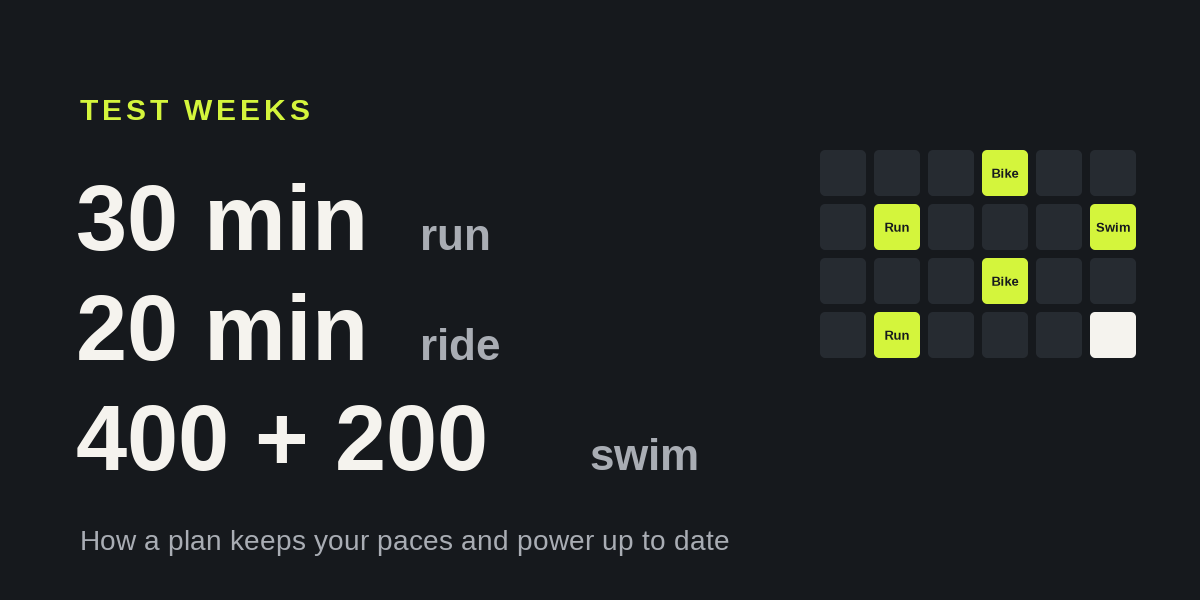
Every pace, power and swim target in your plan comes from one number per sport: your threshold, the effort you could hold for about an hour. That number changes as you train. If your plan still sets your sessions from the threshold you had in September, by January your easy runs may be too slow, your intervals too easy, and your race prediction out of date.
An EnduranceLabs plan measures it again. Every few weeks, in an easier week, one session is a test. The result goes into your profile once you've done it, and your targets update from it.
Three tests, one for each sport
Each test is a published protocol that coaches use. Your plan sends it to your watch with the warm-up built in.
The run: 30 minutes, as hard as you can hold evenly. After an easy warm-up with a few strides, you run 30 minutes on your own, as if it were a race, on flat ground or a track. Your average pace is your threshold pace. If you wear a heart-rate strap, your average heart rate over the last 20 minutes is your threshold heart rate, as the coach Joe Friel describes it. Run it alone: Friel notes that racing someone pushes the number up.
The ride: 20 minutes, with a 5-minute effort first. This is the Allen and Coggan test. A long warm-up with fast pedalling, then 5 minutes all out, a full recovery, then the 20-minute time trial. Your FTP is 95 % of the 20 minutes' average power. The 5-minute effort matters: it uses up the extra power fresh legs have, so the 20 minutes is closer to what you could hold for an hour. Without a power meter, the plan sets a 30-minute ride instead and reads your threshold heart rate from it, as for the run.
The swim: a 400 and a 200, both flat out. After a warm-up, swim a 400 m time trial at the fastest even pace you can hold, swim easy and rest, then a 200 m time trial. Your critical swim speed (CSS) is the difference between the two times, halved, per 100 m. Swim Smooth describes CSS as roughly the pace of a flat-out 1,500 m.
What a result turns into
Three example results, as the app reads them:
| Test | Your result | What it sets |
|---|---|---|
| Run, 30 minutes | 6.0 km | Threshold pace 5:00 /km |
| FTP, 20 minutes | 220 W average | FTP 209 W |
| CSS, 400 + 200 | 7:20 and 3:30 | CSS 1:55 /100 m |
From those numbers come your zones: the easy pace that keeps easy runs easy, the power for a set of intervals, the pace of each swim set. They also move your race predictions. At a 5:00 threshold pace, the running model predicts a 49:27 10K and a 1:49:07 half marathon. Ten seconds a kilometre faster, after a block of training, and it's 47:43 and 1:45:16. Without a test, the plan wouldn't know you'd got there, and your harder sessions would stop pushing you.
Why in an easier week
A test is only useful if it's honest. Tired legs give a low number, and a low number makes the sessions after it too easy. The plan puts tests where your legs are freshest: in an easier week, with nothing else hard around the test.
Your plan also leaves tests out where they'd do more harm than good:
- Not in the run-in to your main race. The weeks before an A race are for race-specific work and the taper. A maximal test then costs more than it tells you.
- Not straight after a race. A race is a better measurement than any test, so the plan uses its result and lets you recover.
- One hard test in a week. A triathlete doesn't do the FTP test and the run test in the same week. The swim test can join either when the week has room.
Two example plans, both starting on 9 November and both to a race on 25 April 2027, show where the tests fall:

The marathon runner tests in three of the five easier weeks. In the other two the last test is still recent, so those weeks stay easy. The triathlete has three sports to keep current, so the tests rotate through them, stalest first.
Re-testing is a balance. Hunter Allen suggests repeating the FTP test every six to eight weeks. Your plan follows the same idea: often enough that your targets keep up with your fitness, seldom enough that testing doesn't take over your training.
How to get an honest number
- Treat it like a race. Sleep, eat as you would before a race, and skip anything hard the day before.
- Use the same place each time. The same track, the same stretch of road, the same pool, the same trainer. Then the next test compares like with like.
- Test before the heat. In an Indian summer, heat and humidity slow your pace and push your heart rate up. Run it before sunrise, or on a treadmill, so the number reflects your fitness and not the weather.
- Pace it evenly. The commonest mistake is a fast first five minutes. Start at an effort you're sure you can hold, and finish with nothing left.
- Don't watch your heart rate. On the run and the heart-rate ride, run or ride by effort and let the watch record. Friel makes the same point.
- Record it properly. The app reads the test from your watch: the 30 minutes of the run, the best 20 minutes of power, the two swims' times from your laps, so check your watch is counting lengths.
Don't force a test through a cold, a heatwave or a sleepless night. The number comes out low, and the targets after it would be too easy.
Train with targets that keep up
An EnduranceLabs plan puts its tests in the right weeks, sends each one to your watch with its protocol, and updates every pace, power and swim target from the result as soon as you've done it.
Sources: the 30-minute test and threshold heart rate from Joe Friel, "Determining your LTHR"; the 20-minute FTP protocol and the six-to-eight-week interval from Hunter Allen, "FTP test: what it is and how to do it"; CSS as about 1,500 m pace from Swim Smooth, "The CSS Test Explained", and the 400 and 200 calculation from MyProCoach, "What is Critical Swim Speed (CSS)?". The example plans, results and predictions come from the EnduranceLabs app, for example athletes.