Strength for runners: the lifts that matter, and when to do them
The lifts that make runners faster and more durable, why they should be heavier than most runners expect, and how strength work changes through a season.
· 6 min read · EnduranceLabs
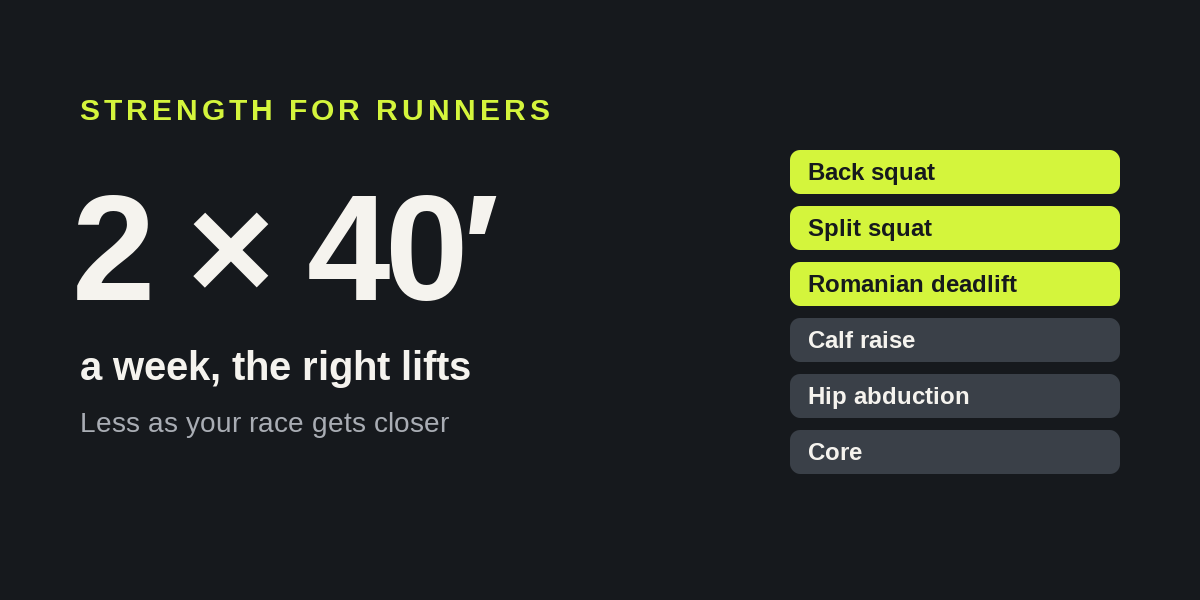
Plenty of runners know they should do some strength work without knowing which lifts matter, how heavy to go, or what to do in the weeks before a race. A handful of lifts covers it, twice a week for most of the season, heavier than most runners expect, and planned around the running.
Why runners should lift
A 2018 systematic review in Sports Medicine by Blagrove, Howatson and Hayes gives the best summary of the evidence. It pulled together 24 studies that compared middle- and long-distance runners who added strength training with runners who only ran. Across the 20 studies that measured it, running economy improved by about 2–8 %: the same pace cost less oxygen. Time trials up to 10 km tended to get quicker, by around 2–4 %, and sprint speed improved. VO₂max and body composition stayed the same, so the runners didn't get bulkier; each stride got cheaper. The review points to two or three sessions a week, mixing heavy lifting with explosive and jumping work.
Lifting also keeps you healthy. A 2014 meta-analysis in the British Journal of Sports Medicine (Lauersen, Bertelsen and Andersen) pooled 25 trials of injury-prevention exercise across many sports, with more than 26,000 participants. Strength training came out best: programmes built on it cut injuries to about a third, and stretching made no measurable difference. Most of those trials weren't in runners, so read the result as a strong general signal, with no guarantee for any one runner.
The lifts that matter
An EnduranceLabs plan builds its runner programme around three main lifts, two accessories and a core pair. Each has a gym version and a no-equipment version, so the same plan works in a full gym in Bengaluru or a flat in Pune with nothing but a step:
| Role | In a gym | With no kit |
|---|---|---|
| Squat | Back squat | Tempo squat (3 s down) |
| Single leg | Rear-foot-elevated split squat with dumbbells | Rear-foot-elevated split squat |
| Hinge | Romanian deadlift | Single-leg Romanian deadlift |
| Calves | Heavy seated calf raise (for the soleus) | Single-leg calf raise off a step |
| Hips | Cable hip abduction | Side-lying hip abduction |
| Core | Copenhagen plank and dead bug | Copenhagen plank and dead bug |
Running is a one-leg-at-a-time sport, so the split squat and single-leg work matter as much as the squat. The Romanian deadlift loads the hamstrings and glutes through a hinge, the movement that drives you forward. The soleus, the deep calf muscle under the gastrocnemius, works with each stride, and a seated, bent-knee calf raise lets you put a heavy load on it. Hip abduction and the Copenhagen plank (a side plank with the top leg on a bench) work the muscles that keep your pelvis and knee in line on tired legs. In the race-specific weeks you add pogo hops and box or step jumps to keep your legs springy.
How heavy
Many runners shy away from "heavy". Light weights for high reps feel closer to running, but most of the studies in the review used heavy lifting (loads you could lift fewer than nine times, or at least 80 % of a one-rep max) alongside explosive and jumping work. Heavy stops short of failure. Your plan sets each lift by reps in reserve: how many more you could have done. With two in reserve, the last rep is hard but clean.
Your plan works out the weight from the sets you log, and moves it as you get stronger. Near a race it keeps the weight and cuts the volume, enough to hold your strength without leaving your legs heavy for race-pace running. With no weights, slow single-leg reps stand in for the heavy lifts, with a loaded backpack once they get easy.
When: strength through a season
Your strength work changes through the season. The chart follows the same example: an intermediate runner training five days a week, with a half marathon 16 weeks away and a gym to train in.

Three principles shape it:
- Foundation first. A couple of weeks of moderate weights and slow lowering teach you the lifts and prepare your tendons before anything heavy.
- Heavy through the base and build, when most of the running is easy and you have room to recover from lifting.
- Less as the race nears. A single maintenance session a week in the race-specific block, and no leg work at all in the final days before a race, so you start on fresh legs.
A cautious plan, or a short training week, gets one session a week.
Where it goes in the week
Your plan fits strength in around the running, on two principles: not the day before a hard or long run, and where possible after an easy run on the same day, so your rest days stay restful. A build week of the same plan:
| Day | Training |
|---|---|
| Mon | Rest |
| Tue | Threshold run (60 min) |
| Wed | Easy run with strides (55 min), then strength, heavy (40 min) |
| Thu | Easy run (55 min), then strength, heavy (40 min) |
| Fri | Rest |
| Sat | Easy run (55 min) |
| Sun | Long run, finishing at race pace (110 min) |
Run first and lift second, because the run is the priority. Lifting on an easy-run day, straight after the run or that evening if you ran early, leaves your hard days free for hard running.
Getting started
- Learn the lifts light. The foundation weeks are for form. Film a set if you have no coach.
- Log each set: the weight, the reps and how many you had left. Your plan sets the next session's load from them.
- Expect some soreness at first. It eases as you get used to the lifts; keep the first sessions light.
- Keep lifting when the mileage climbs. Those are the weeks strength work helps most.
Strength that fits around your running
Your EnduranceLabs plan includes strength for your sport, written for the kit you have, placed around your runs and eased off before your races. Log your sets and the weights move with you.
Sources: the effects on running economy and performance from Blagrove, Howatson and Hayes, "Effects of Strength Training on the Physiological Determinants of Middle- and Long-Distance Running Performance: A Systematic Review", Sports Medicine, 2018; the injury figures from Lauersen, Bertelsen and Andersen, "The effectiveness of exercise interventions to prevent sports injuries", British Journal of Sports Medicine, 2014, as summarised on the BJSM blog. The programme, the season and the week come from the EnduranceLabs app (plan version 2.8.0), for an example athlete.