HYROX Relay: what each leg costs, and which two to take
Each HYROX Relay leg predicted for median athletes, from the 7-minute farmers carry to the 11½-minute wall balls, with the rulebook's handover rules and how to split a Mixed team.
· 6 min read · EnduranceLabs
A HYROX Relay is the full race split four ways. Each of you runs two of the eight kilometres and does the station after each, and the team decides who takes which. That choice matters more than it looks: the legs aren't equal, and in a Mixed team the right split is worth about two minutes.
HYROX Bengaluru, at BIEC in May 2027, lists a Relay alongside Singles and Doubles, so if your gym is putting a team together, now is a good time to agree the legs and train for them.
The rules that shape the race
From the official HYROX Team Relay rulebook for season 26/27:
- Four of you, two legs each. A team is four women, four men, or two women and two men. Each of you runs 2 × 1 km and does the two stations that follow your runs. The team decides who takes which legs.
- Back to back is allowed. One of you can take two legs in a row. If you do, run through the Transition Zone after your first station so the timing chip registers it, or the team takes an automatic penalty.
- The handover is a high five. It happens in the Transition Zone. The next athlete may only enter shortly before the exchange, and you can't wait around in it.
- Your own loads. Each of you works at your own Open loads: in a Mixed team, the women push 102 kg and the men 152 kg on the sled, and each throws to their own wall-ball target (2.70 m and 3.00 m).
- You finish together. Once the last athlete starts the wall balls, the other three come in through the Relay entry point and stand under the rig. After the hundredth rep, all four run to the finish line together.
What each leg costs
There's no published dataset of Relay splits, so the times below come from EnduranceLabs' HYROX model. It takes the median Open race and runs each leg fresh: the kilometre at about 10K race pace and the station without the fatigue of the stations before it. Treat them as a guide to how the legs compare; your own times will move them.

| Leg | Station | Men's team | Women's team |
|---|---|---|---|
| 1 | SkiErg | 9:27 | 10:37 |
| 2 | Sled push | 7:59 | 8:18 |
| 3 | Sled pull | 9:29 | 10:34 |
| 4 | Burpee broad jumps | 10:14 | 11:38 |
| 5 | Row | 9:43 | 10:45 |
| 6 | Farmers carry | 7:05 | 7:57 |
| 7 | Sandbag lunges | 9:54 | 10:43 |
| 8 | Wall balls | 11:33 | 12:20 |
| Team finish | 1:15:26 | 1:22:52 |
Four median men finish about 11 minutes ahead of the median Singles race (1:26:30), and four median women about 12 minutes ahead of theirs (1:35:00). You run each kilometre on fresh legs and start each station with your breath back.
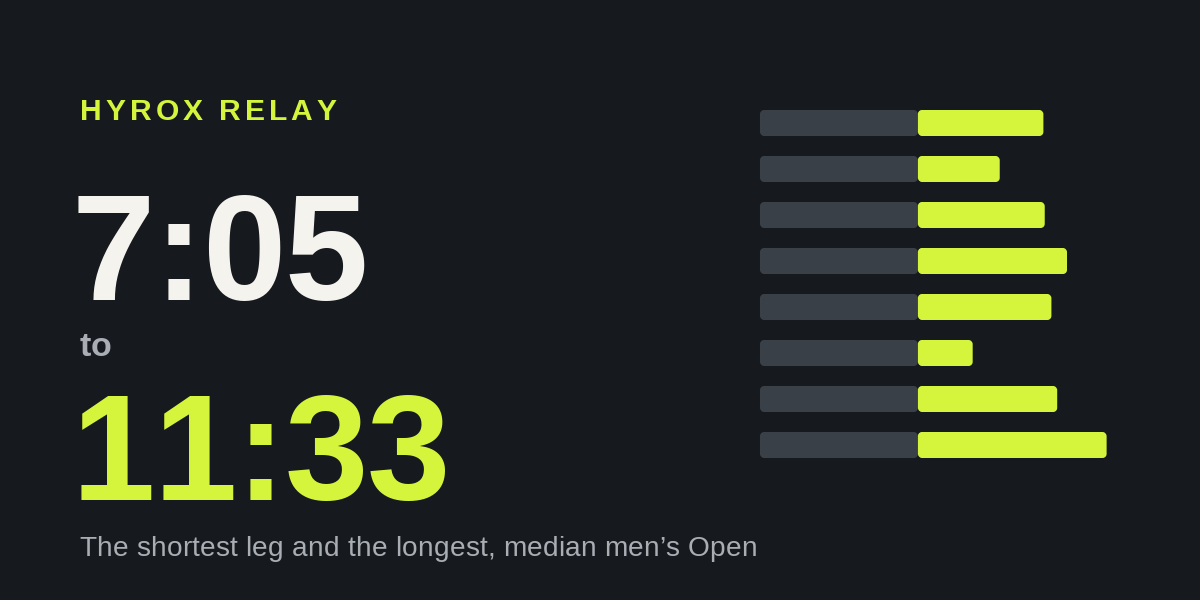
The run takes about the same on every leg, so the station decides the leg. The farmers carry is the shortest, at about seven minutes; the wall balls are the longest, at over eleven. Whoever takes leg 8 also does the last wall balls with the whole team standing under the rig.
Taking two legs each
With four athletes at one level, pair a long leg with a short one. Taking the longest with the shortest, then working inwards, gives each of you 18 to 19½ minutes of work in a men's team:
- legs 6 and 8, the farmers carry and the wall balls: 18:39;
- legs 2 and 4, the sled push and the burpees: 18:14;
- legs 3 and 5, the sled pull and the row: 19:12;
- legs 1 and 7, the SkiErg and the lunges: 19:21.
None of these pairs is back to back, so each of you gets a long rest between your two legs.
With a mix of strengths, give each station to the one who's best at it. A team's time is the sum of its eight legs, so a strong rower should row even if it leaves someone else with the wall balls. Even work only matters as a tie-break: if two of you are as good as each other at a station, give it to the one with the lighter other leg.
Avoid back to back unless you have to. The model puts a second leg straight after the first at about 16 to 24 seconds slower than the same leg run fresh, and the rulebook's chip rule adds a run through the Transition Zone you mustn't forget. If a teammate can only do the end of the race, legs 7 and 8 together cost the team about 23 seconds.
Mixed: who takes what
In a Mixed team each of you works at your own loads, and the gap between a woman's and a man's leg differs from station to station. For median athletes:
| Leg | Station | A woman's leg against a man's |
|---|---|---|
| 1 | SkiErg | +70 s |
| 2 | Sled push | +19 s |
| 3 | Sled pull | +64 s |
| 4 | Burpee broad jumps | +84 s |
| 5 | Row | +63 s |
| 6 | Farmers carry | +51 s |
| 7 | Sandbag lunges | +48 s |
| 8 | Wall balls | +46 s |
The women's sled is 50 kg lighter, so the sled push costs a woman only about 19 seconds more than a man. The burpees and the ergs, the same work for women and men, cost a minute or more.
The fastest Mixed split gives the women legs 2, 6, 7 and 8 (the sled push, the farmers carry, the lunges and the wall balls) and the men the SkiErg, the sled pull, the burpees and the row. For four median athletes that's a 1:18:11 finish, against 1:20:07 the other way round: 1:56 from the leg plan alone. To keep both women off back-to-back legs, one takes the sled push and the lunges, the other the farmers carry and the wall balls.
Your own team may differ. A woman who rows well against your men should row. Start from this split and move legs where your own station times say so.
On race day
- Run your kilometre as a hard 10K effort. You're fresh and you only have two, but going out at 5K pace will cost you at the station. Runners at 4:00 per kilometre or faster must use the inside Fast Lane.
- Warm up for your leg, not the start. If you have legs 4 and 8, you may not move until half an hour after the gun. Warm up again before each leg, then go to the Transition Zone only when your teammate is close.
- Know the order of handovers. Write the legs on your arm next to your start time: who hands to whom, and who takes leg 8.
- Agree the finish. The three who are done head for the wall-ball station by the spectator route once the last leg begins, so be there when the last athlete starts the wall balls.
Predict your Relay
In EnduranceLabs, choose Relay for your HYROX race. Event Lab predicts your team's finish from your own station times, suggests the two legs you're relatively strongest at, and paces both of them.
Predict your Relay in Event Lab → · Build your plan →
Sources: the format, the Transition Zone, the loads and the finish from the HYROX Team Relay rulebook, season 26/27; the Bengaluru event from HYROX Bengaluru. Leg times are EnduranceLabs predictions (HYROX model 1.0.0, team model 1.1.0) for median Open athletes, from the median Open race the model uses, built from published analyses of 2025/26 results; there is no published Relay dataset to check them against.