HYROX Doubles: where the time goes, and how to split every station
The time HYROX pairs save over Singles at each station, from the medians of 676,000 Doubles teams, and the splits that share the SkiErg, sleds, burpees and wall balls.
· 5 min read · EnduranceLabs
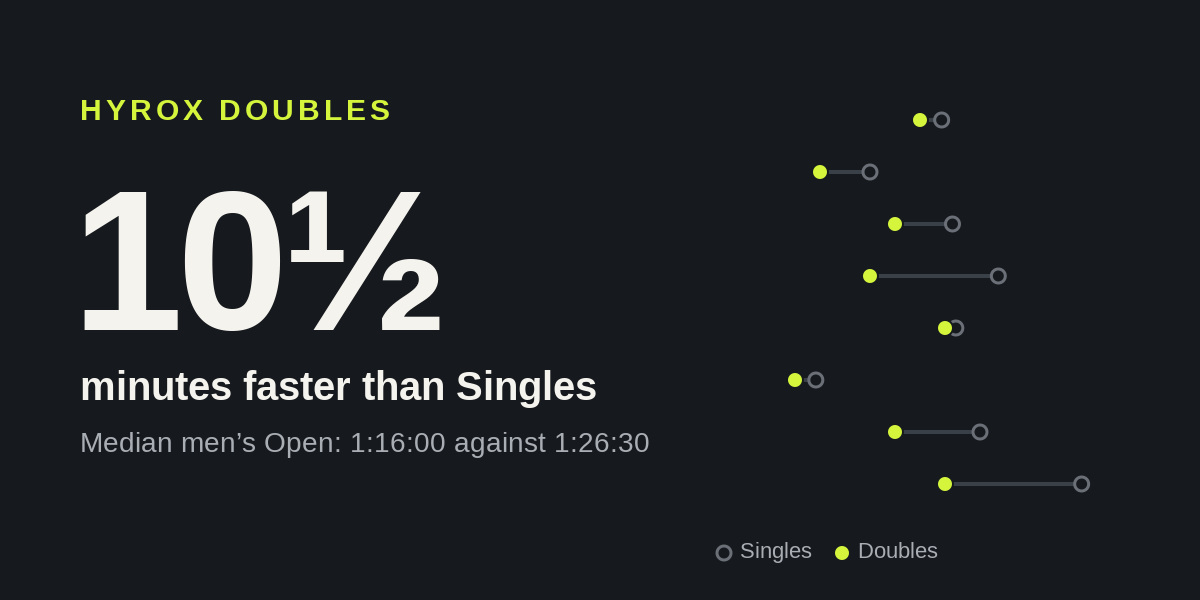
Doubles is HYROX for two: the same eight kilometres and eight stations, but you run each kilometre together and share the work at each station. It's quicker, too. The median men's Doubles team finishes in about 1:16, ten and a half minutes ahead of the median Singles race.
The saving varies by station. With two of you the row takes 13 seconds less, and the burpee broad jumps close to half the time. Plan your split station by station with that in mind.
The rules that shape the race
From the official HYROX Doubles rulebook for season 26/27:
- You run together. Both of you run each kilometre side by side. If one of you runs ahead, you get a one-minute penalty, and a team with more than three goes unranked.
- One works, one rests. At each station one of you works while the other rests, and you switch as often as you like ("you go, I go"). You enter each station together and leave together once you've finished it.
- Full loads. Doubles uses the same weights as Singles: Women's Doubles the women's Open loads; Men's, Women's Pro and Mixed the men's Open loads; Men's Pro the Pro loads.
- Mixed. The woman works at the men's Open loads (a 152 kg sled push, a 103 kg sled pull, 2 × 24 kg for the carry, a 20 kg sandbag and a 6 kg wall ball) and throws to her own 2.70 m target.
Where Doubles is faster

| Men's Open | Singles | Doubles | Saved |
|---|---|---|---|
| SkiErg | 4:26 | 4:00 | 26 s (10 %) |
| Sled push | 3:00 | 2:00 | 1:00 (33 %) |
| Sled pull | 4:39 | 3:30 | 1:09 (25 %) |
| Burpee broad jumps | 5:34 | 3:00 | 2:34 (46 %) |
| Row | 4:43 | 4:30 | 13 s (5 %) |
| Farmers carry | 1:55 | 1:30 | 25 s (22 %) |
| Sandbag lunges | 5:12 | 3:30 | 1:42 (33 %) |
| Wall balls | 7:14 | 4:30 | 2:44 (38 %) |
| All eight stations | 36:43 | 26:30 | 10:13 |
| Runs | 43:47 | 42:30 | 1:17 |
| Roxzone | 6:00 | 6:30 | 30 s slower |
| Finish | 1:26:30 | 1:16:00 | 10:30 |
The burpees and wall balls gain most. In Singles they're the two longest stations: 80 m of burpee broad jumps and 100 wall balls on legs that have already done six or seven stations. In pairs, each turn is short and you start it with some breath back. Together the two stations save about five minutes, half of what Doubles gains on the stations.
The ergs gain least. The SkiErg and the row are 5–10 % faster. On an erg your pace comes from the power you can hold, which fresh legs change little, and each switch costs a few seconds. Sharing cuts the distance each of you rows or skis; your pace on the machine stays about the same.
The runs and the Roxzone stay about the same. You do half the station work, so your legs stay fresher, but you run at the pace you can both hold. The men's median runs are about a minute quicker than Singles in total, and the Roxzone takes half a minute longer, with two people moving in and out of each station.
Women's Doubles follows the same pattern: the median team finishes in 1:27:30, seven and a half minutes ahead of the median Singles race. The wall balls are 40 % faster and the burpees 39 %; the SkiErg and the row gain little. The median Mixed team, at 1:22:30, sits between the two.
How to split every station
Start with even splits. These keep turns short and handovers clean, and each comes with the rulebook's handover rule:
- SkiErg: 4 × 250 m, two turns each. The resting partner waits in the marked area, and you can't pass the handles between you.
- Sled push: a length each, two each. The resting partner walks behind the sled and stays out of the next lane.
- Sled pull: a length each, two each. The resting partner stays behind, keeps off the rope and can only cheer.
- Burpee broad jumps: 20 m each, two turns. The next partner starts with their hands where the last one's feet landed.
- Row: 4 × 250 m, two turns each. Switch fast, as on the SkiErg: the clock keeps running while the seat is empty.
- Farmers carry: 50 m each, two turns. Hand the kettlebells over sideways or backwards; a forward handover breaks the rules.
- Sandbag lunges: 25 m each, two turns. The same applies: pass the sandbag sideways or backwards.
- Wall balls: sets of 10, alternating. Hand the ball over or let it drop; a throw-and-catch handover doesn't count. In Mixed, each of you hits your own target.
When not to split evenly
Your time at a station is the sum of both your turns, so give more of a station to whichever of you is stronger at it: three turns of five, or three lengths of four. Don't let them empty themselves before a run you both have to finish together.
In Mixed Doubles the woman works at the men's loads, so the man often takes more of the sleds, the carry and the lunges. Share the ergs, the burpees and the wall balls half and half.
Switch when your plan says, before either of you is spent. Two short turns are quicker than one long one.
Running together
Run the first kilometre at the pace the slower of you can hold for all eight. It's the easiest one to go too fast on, and you pay for it at the stations. Agree on one word for "ease off" before race day, and use it.
Predict your Doubles time
In EnduranceLabs, choose Doubles or Relay for your HYROX race. Event Lab predicts your team's finish and suggests a split for each station from your own station times: even, or more turns for one of you. In Mixed it shows who should take the heavy stations, and for a Relay it paces your two legs. On race day your race plan reaches your watch as a workout.
Predict your Doubles time in Event Lab → · Build your plan →
Sources: the format and the handover rules from the HYROX Doubles rulebook, season 26/27; Doubles medians from MatchRox's analysis of 676,202 Doubles teams (seasons 4–9, refreshed 8 October 2026; each split rounded to the half minute, so the parts don't quite add up to the finish); Singles medians from the median Open race EnduranceLabs predicts from, built from published analyses of 2025/26 results. The two come from different analyses, so treat each station's difference as approximate.