Running in Delhi's winter air: when to train outside, and when to move the session
We looked at four winters of Delhi's air, hour by hour. The early-morning run falls in some of the day's worst air, and mid-afternoon in the cleanest.
· 5 min read · EnduranceLabs
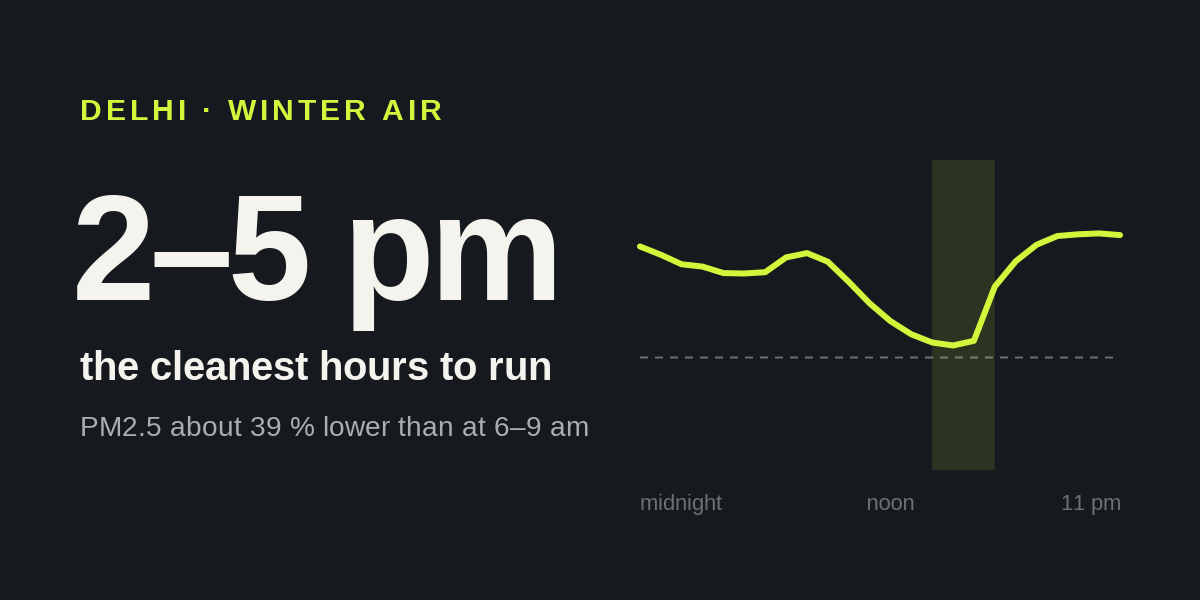
Most Delhi runners train before work, and in winter that puts them in some of the day's worst air. Across four winters, the fine particles in the city's air (PM2.5) were lowest between 2 and 5 in the afternoon, about 39 % below the level between 6 and 9 in the morning.
You can't run at 3 pm every day, and on the worst days no hour is good. Once you know how the air changes through the day, you can put each session at a better hour and take some indoors.
The data
We took hourly PM2.5 for central Delhi from Open-Meteo's air-quality service for November, December and January of the four winters it covers, 2022/23 to 2025/26. The numbers come from the European Copernicus (CAMS) atmospheric model on a grid about 45 km across. They describe the city's air in general, and a monitor beside a busy road will often give different readings. Use them for the pattern through the day: the better hours and the worse ones.
For scale, India's national standard for PM2.5 averaged over 24 hours is 60 µg/m³ (micrograms per cubic metre).

Hour by hour
| Median PM2.5 (µg/m³) | November | December | January | All three |
|---|---|---|---|---|
| 5–8 am | 107 | 98 | 118 | 108 |
| 8–11 am | 104 | 106 | 121 | 109 |
| 11 am–2 pm | 72 | 75 | 92 | 80 |
| 2–5 pm | 62 | 62 | 77 | 68 |
| 5–8 pm | 107 | 105 | 119 | 110 |
| 8–11 pm | 121 | 115 | 139 | 126 |
Early morning is among the worst times to run. The air is already heavy before dawn and gets a little worse as the morning traffic starts, peaking around 7–8 am. At 6:30 am you breathe air with about 60 % more fine particles than in mid-afternoon.
The afternoon is the cleanest by a long way. From late morning the level falls to its lowest at about 3 pm. The standard explanation is the sun: as it warms the ground, the air near the surface mixes upwards and spreads the pollution through a far bigger volume. After sunset the air near the ground cools, the mixing stops and the level climbs again.
The evening is worst. After 5 pm the level rises fast, and from 8 pm to midnight it's higher than at any other time of day, so moving your run to after work makes things worse.
Bad days
Picking the hour helps, and picking the day helps more. On the 24-hour average, Delhi's winter days went over the standard this often:
| Days over 60 µg/m³ | Days over 120 µg/m³ | |
|---|---|---|
| November | 92 % | 30 % |
| December | 87 % | 34 % |
| January | 96 % | 45 % |
About nine winter days in ten are over the standard, and a third or more are over twice it. In this data January is the worst month on average, worse than November.
Breathing hard in bad air
Each minute of running moves far more air through your lungs than a minute sitting down, so more of whatever the air carries reaches them. The harder the session, the more air you take in. The advice below follows from that. It's general training sense and no substitute for medical advice: if you have asthma, or a heart or lung condition, follow your doctor's advice on when to train outside.
Training outside
- Move easy runs to the afternoon when you can. Weekends give you the best chance: a long run from 1 or 2 pm is in cleaner air than one at 6 am.
- Lunchtime is the next best. From 11 am to 2 pm the air is already better than at dawn: a median of 80 against 108.
- Put hard sessions on the better days. Intervals and tempo runs make you breathe hardest. On a day well over the standard, take them indoors to a treadmill or an indoor bike, or move them to a cleaner day in the same week.
- On the worst days, ease off. On a day over twice the standard, keep the run short and easy, take it indoors or skip it. Missing one easy run costs you next to no fitness.
- Check before you go. Look up a live reading from the monitoring station nearest your route. Use the pattern above to pick the hour, and today's reading to decide whether to go.
- Avoid the busiest roads. At any hour, a park or a quiet street beats the side of a main road.
Your plan in bad air
You don't have to rebuild your week by hand. In EnduranceLabs:
- Move a session to another day in the coming weeks: the tempo run from a bad Tuesday to a better Thursday, say. If the move puts two hard days back to back, you can still make it; the app warns you and offers an undo.
- Mark time unavailable when you can't train outside for a stretch, or you leave the city to get away from the air. Your plan works around those days without you doing anything. After a break of a week or more, your first week back is lighter than it would have been, so you build back up.
- Let the plan set the load. You don't enter how hard a week should be; the plan adjusts to the training you do.
Moving sessions all winter, and skipping a few runs on the worst days, costs you less fitness than doing hard intervals in the dirtiest air of the day.
Sources: hourly PM2.5 for central Delhi (28.61° N, 77.21° E) from the Open-Meteo air-quality API (CC BY 4.0), CAMS global model data from the Copernicus Atmosphere Monitoring Service, November–January 2022/23–2025/26, medians by hour in Indian time; the 24-hour PM2.5 standard from the Central Pollution Control Board's National Ambient Air Quality Standards (notification of 18 November 2009). Model data at a 45 km scale: local readings differ.