80/20 training: how easy is easy, and why it's most of the work
Most endurance training should be easy. The research behind 80/20, how a plan counts the split week by week, and how to keep your easy runs easy.
· 5 min read · EnduranceLabs
Many runners who stop improving train in the middle. Each run is a little quicker than it should be: too hard to recover from, too easy to make you fitter. The fix, 80/20, sounds like a slogan, but it's one of the best-supported ideas in endurance training, and EnduranceLabs builds its plans on it.
Where 80/20 comes from
Sports scientists have logged what the best endurance athletes do in training, from recorded sessions, and found the same pattern across sports. A 2023 review in Frontiers in Sports and Active Living pooled 175 recorded training distributions of elite runners, rowers, cyclists, skiers, swimmers and triathletes. The median was 85 % of endurance training at low intensity, below the first lactate threshold, and in nine out of ten distributions more than 60 % was easy. Runners stayed around 82–83 % easy in both preparation and the racing season.
For athletes below elite level, a 2014 study in Frontiers in Physiology split 48 well-trained runners, cyclists, triathletes and skiers into four groups for nine weeks: high volume (long and easy), threshold, high-intensity intervals, or "polarised" (easy, with a small dose of hard work). The polarised group improved most, with VO₂peak up about 12 % and time to exhaustion up about 17 %. The threshold group, training in the middle, changed little. The study was small and had no control group, so treat the size of the gaps with care; the direction matches the elite logs.
Easy running builds the engine (capillaries, mitochondria, tendons that tolerate mileage), and you can do a lot of it and still recover. Hard sessions sharpen that engine, and a few a week are enough to pay off. Training in the middle costs close to what hard work costs and builds less than either.
How a plan counts it
An EnduranceLabs plan keeps most of each week easy, with at most about a fifth of your endurance time at moderate or hard intensity. HYROX plans allow more, because the stations are hard by nature.
Two details decide how the minutes count:
- Warm-ups, cool-downs and the recoveries between reps count as easy. A 55-minute threshold session of 5 × 5 minutes is 25 minutes hard and 30 minutes easy. A 2-hour long run with the last 30 minutes at race pace is 90 minutes easy.
- Strength sessions and test sessions sit outside the count. The split covers your running (or riding, or swimming) time.
The plan also limits how many hard sessions you do in a week, and the limit rises with your experience.
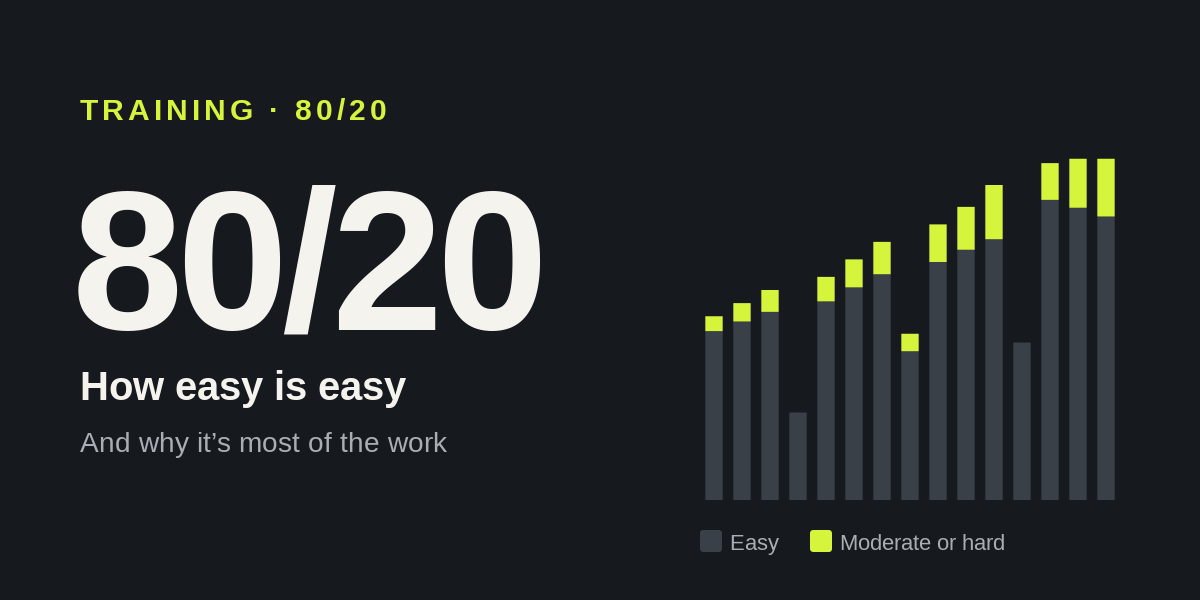
As an example, take an intermediate runner who runs about 3½ hours a week over five days, with a half marathon 16 weeks away. Their EnduranceLabs plan looks like this:

Across the 15 weeks before race week, the plan comes out at 88 % easy and 12 % moderate or hard, under a fifth in each week. The plan treats a fifth as a limit to work up to: the base block is close to all easy, the hard work grows through the build, and every few weeks an easier week brings it back down.
The hard work comes in two forms: one structured session a week and, from the build on, a long run that finishes at race pace. The rest of the week is easy, with no "tempo-ish" running in between.
How easy is easy
Easy is slower than feels natural, more so at first. Your EnduranceLabs plan sets your easy pace and heart rate from your threshold, about the pace or heart rate you could hold for an hour flat out, and measures it with a 30-minute test in its test weeks.
By pace, easy comes out around a minute or more per kilometre slower than your threshold pace, and the plan gives it as a range, so a slow day still counts. By heart rate, your easy runs have a ceiling set below your threshold heart rate.
In much of India, the heart-rate ceiling is the better guide for most of the year. Heat and humidity push your heart rate up at any pace, so on a sticky morning in Mumbai or Chennai the same easy effort comes out slower than in December. Go by your heart rate on those days, and keep it under the ceiling even if that means walking a hill. With no heart-rate monitor, use the talk test: you should be able to speak in full sentences.
Making it work
- Run your easy days easy, even when you feel good. Feeling good on an easy day means you'll be ready for the hard one.
- Don't add pace to the long run. Unless your plan puts the last part at race pace, run the long run at easy pace from start to finish.
- Don't swap an easy run for a group's tempo run. If you run with a club, run with the slower group on easy days.
- Make the hard sessions count. With one or two a week, hit the paces. If you can't, your easy days may not have been easy enough.
- Strides don't count as a hard session. The six short strides after some easy runs add up to a couple of minutes of quick, relaxed running for form, too little to change the split.
Train 80/20 with a plan that counts it for you
An EnduranceLabs plan sets your easy and hard paces from your own test results, keeps most of each week easy, and moves sessions when your week changes. Each session goes to your watch with its targets.
Sources: the elite training distributions from Sperlich, Matzka and Holmberg, "The proportional distribution of training by elite endurance athletes at different intensities during different phases of the season", Frontiers in Sports and Active Living, 2023; the nine-week training study from Stöggl and Sperlich, "Polarized training has greater impact on key endurance variables than threshold, high intensity, or high volume training", Frontiers in Physiology, 2014. The example plan and its weekly split come from the EnduranceLabs app (plan version 2.8.0), for an example athlete.